Professor Mallard’s Travels / Iceland
In a land of black lava, restless ground, and drifting steam, Professor Mallard discovers that the most compelling water story may begin at an ordinary cold tap.
THE EXPEDITION AT A GLANCE
Destination: Iceland · Reykjavík and a fictional journey through volcanic country
In the glass: Cold drinking water from a guesthouse tap
Under discussion: Geology, water sources, and the art of paying attention
The Professor’s verdict: Worth writing home about. At length.
01 · An urgent appointment with the Earth
The Professor Packs for an Argument
Professor Mallard arrived in Iceland with three tasting glasses, two woollen scarves, and a letter bearing the words a matter of geological importance.
He had written the letter himself.
“It helps,” he explained to his travelling companion, “to establish the seriousness of an expedition before anyone enquires about the luggage.”
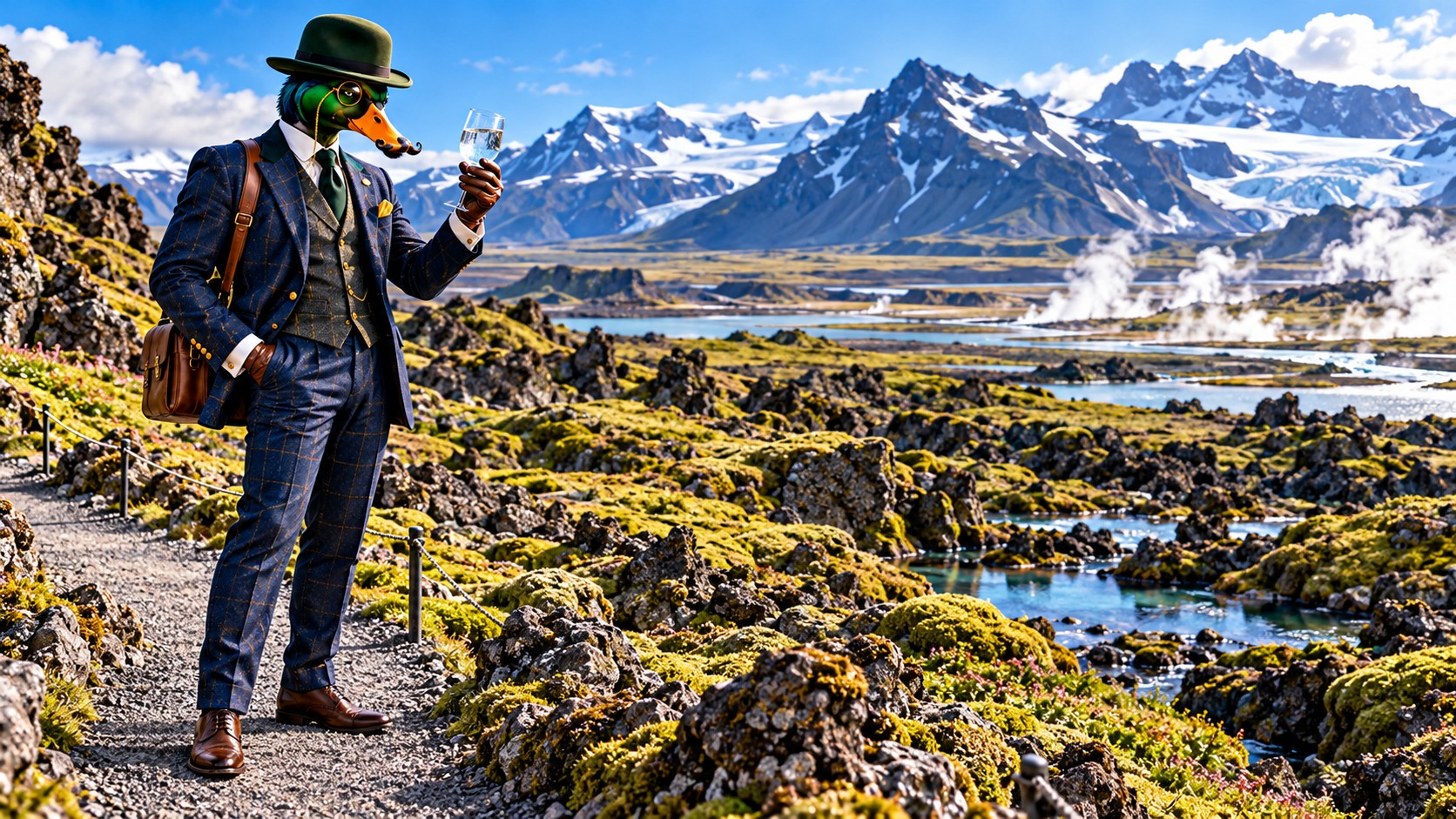
Beyond the airport windows, dark lava stretched beneath a wide northern sky. The landscape appeared to have been assembled by a sculptor who considered restraint an unnecessary inconvenience. Here were black rock, pale light, distant mountains, and moss so luminous that the Professor briefly suspected it of showing off.
His companion suggested a coffee. The Professor requested a map.
“We are visiting an island where the ground has an active interest in its own construction,” he said. “Refreshments can wait until we have discussed the foundations.”
02 · A landscape still becoming
Where the Map Refuses to Sit Still
Iceland sits across the Mid-Atlantic Ridge, where the North American and Eurasian tectonic plates move apart. On Reykjanes, part of that largely submarine ridge extends onto land: a remarkable setting in which to consider the making of the Earth.
The Professor regarded the volcanic landscape from an established path, his monocle catching the low light.
“Most destinations offer a history,” he observed. “This one appears to be drafting the next edition.”
His companion asked whether the rocks would affect the water.
The Professor turned with the delighted expression of a gentleman who has finally been asked the correct question.
“Now,” he said, opening his notebook, “we may begin.”
Water and rock have a complicated acquaintance. As water travels through the ground, it can interact with the materials it encounters. Its eventual character depends on its particular source and journey. A volcanic landscape does not give every glass the same mineral composition, and the word Icelandic is the beginning of an enquiry, not a complete tasting note.
03 · The discovery at the cold tap
A Rather Extraordinary Ordinary Glass
The expedition’s most memorable tasting did not take place beside a dramatic waterfall or at the edge of a steaming pool.
It happened at a small guesthouse in Reykjavík.
Their host placed a glass of cold drinking water on the table. There was no embossed bottle, no elaborate presentation, and certainly no suggestion that the glass required a velvet cushion.
“From the tap,” she said.
The Professor looked at the water. Then at the tap. Then, with admirable professionalism, back at the water.
He took a sip.
In his notebook he recorded a cool, gentle impression: a light-feeling texture, a quiet finish, and very little standing between the first sip and the desire for another. These were his impressions of this fictional glass, not a laboratory analysis or a verdict on every water in Iceland.
“An extremely composed performance,” he announced.
“It is our drinking water,” said the host.
“Yes,” said the Professor. “That is precisely what makes it interesting.”

04 · Beneath the surface
The Journey Before the Glass
In the real Reykjavík region, Veitur identifies Heiðmörk as its main water-extraction area for the capital and describes the supply there as clean, untreated groundwater. The city’s public-health authority also takes drinking-water samples from the distribution network each week.
To the Professor, that combination mattered: a source worth protecting, and people doing the practical work of looking after it.
“A beautiful landscape is a splendid introduction,” he said. “A well-managed drinking-water supply deserves a proper thank-you.”
He resisted the temptation to assign exact mineral figures to his guesthouse glass. A photograph cannot reveal a water’s chemistry; neither can a particularly confident moustache. Proper measurements require appropriate analysis.
Instead, he compared small sips at the same temperature and paid attention to texture, intensity, and finish. His companion, who had expected an afternoon of sightseeing, found himself discussing the difference between delicate and uninteresting.
“A whisper,” the Professor said, “is perfectly capable of saying something worthwhile.”
THE PROFESSOR’S FIELD METHOD
Know the source.
Observe the glass.
Leave room for surprise.
05 · Two very different invitations
Steam Is a Spectacle, Not a Tasting Note
Later, watching steam drift across a geothermal landscape, the Professor drew a firm line in his notebook.
On one side he wrote drinking water. On the other he wrote geothermal scenery.
Iceland’s geothermal resources supply heat as well as memorable landscapes. They are a different subject from the cold drinking water in his glass. An inviting colour, a clear surface, or an impressive plume of steam does not make an unfamiliar pool a place to drink.
The Professor kept his tasting glasses packed, stayed on the designated route, and admired the scene from where visitors were meant to stand.
“One may appreciate a geological phenomenon,” he remarked, “without attempting to swallow it.”
His companion considered this the most reassuring sentence of the expedition.
06 · The verdict
Of Considerable Geological Importance
By the end of the journey, the Professor’s notebook contained sketches of basalt, observations on cold water, and a lengthy complaint about the wind’s treatment of his hat.
What stayed with him, however, was the guesthouse table.
He had crossed a dramatic landscape expecting the extraordinary to arrive with appropriate ceremony. Instead, it had appeared in an ordinary glass, offered without a speech.
The discovery did not diminish the mountains, the lava, or the immense workings beneath the island. It connected them to something human: a host welcoming a traveller, a protected source, and the everyday pleasure of a good drink of water.
“Was the expedition important?” his companion asked as they packed.
“Geologically,” replied the Professor.
“And the water?”
He closed his notebook.
“A very persuasive argument for paying attention.”
“A whisper is perfectly capable of saying something worthwhile.”
— Professor Mallard, Esq.
Real places, researched context
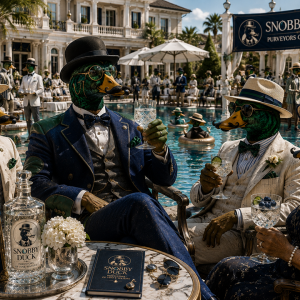
This is a fictional Professor Mallard adventure. Characters, dialogue, itinerary, and tasting impressions are invented. The illustrations are AI-generated artwork, not documentary photographs.
Background reading: IUGS: The Mid-Atlantic Ridge on Reykjanes · Veitur: Water conservation and the Heiðmörk supply · Reykjavík: Drinking-water sampling · Visit Iceland: Geothermal energy.