
Professor Mallard’s Travels / Kyoto, Japan
In a quiet Kyoto tea shop, Professor Mallard discovers that the right water does more than hold the leaves. It helps the whole cup find its character.
INSIDE THE TASTING NOTEBOOK
Destination: Kyoto, Japan
Discovery: Water’s role in Japanese green tea
On the table: Sencha, two drinking waters, and an open mind
The lesson: A water’s character can be appreciated alone and in company.
01 · An appointment in Kyoto
The Professor Comes Prepared
Professor Mallard arrived in Kyoto carrying a leather tasting case, a freshly sharpened pencil, and the comfortable conviction that water was quite capable of being interesting on its own.
This conviction had survived mountains, long train journeys, and several dinners at which nobody had actually asked about bicarbonate.
His travelling companion had arranged a visit to a small tea shop.
“An excellent opportunity,” said the Professor, adjusting his gold monocle. “One should always understand the water before it acquires additional responsibilities.”
Outside, the afternoon light caught the timber fronts of the street. A bicycle bell sounded somewhere behind them. Inside, the shop was quiet enough for the small sounds to matter: a lid settling on a pot, cups placed on a tray, the soft movement of water.
The Professor took out his notebook.
For once, he waited before opening his mouth.
02 · Before the leaves
A Glass Without a Speech
Their host began with a glass of drinking water.
The Professor approved of the order of proceedings. He examined the glass, took a small sip, and considered the finish with the concentration of a man reviewing a particularly important treaty.
In this fictional tasting, the water struck him as gentle and lightly textured. It did not demand attention. It simply made another sip seem like a sensible idea.
“Very composed,” he observed.
The host smiled and placed a small teapot beside the glass.
“And now,” she said, “let us see what it does with tea.”
The Professor looked at his companion.
His companion looked relieved that someone else had taken charge of the conversation.
03 · A meeting of characters
When Water Met Its Match
The tea was sencha: loose-leaf Japanese green tea, prepared in a side-handled pot called a kyusu. Their host measured the leaves and water with an ease that made the Professor’s travelling equipment seem faintly excessive.
He watched the pour. Pale green-gold tea gathered in the cup.
The first sip was a small surprise.
He noticed a fresh, green fragrance, a rounded savoury impression, and a little briskness at the finish. The water he had just considered so restrained now seemed to be taking part in something rather more expressive.
“There is considerably more conversation in this cup,” he said.
“You have introduced the leaves,” replied the host.
He took another sip, then returned to the plain water.
It was still itself. Yet he was thinking about it differently. He had spent so much time asking what a water said alone that he had occasionally forgotten to ask what it might help someone else say.
04 · The second cup
The Same Tea, a Different Conversation
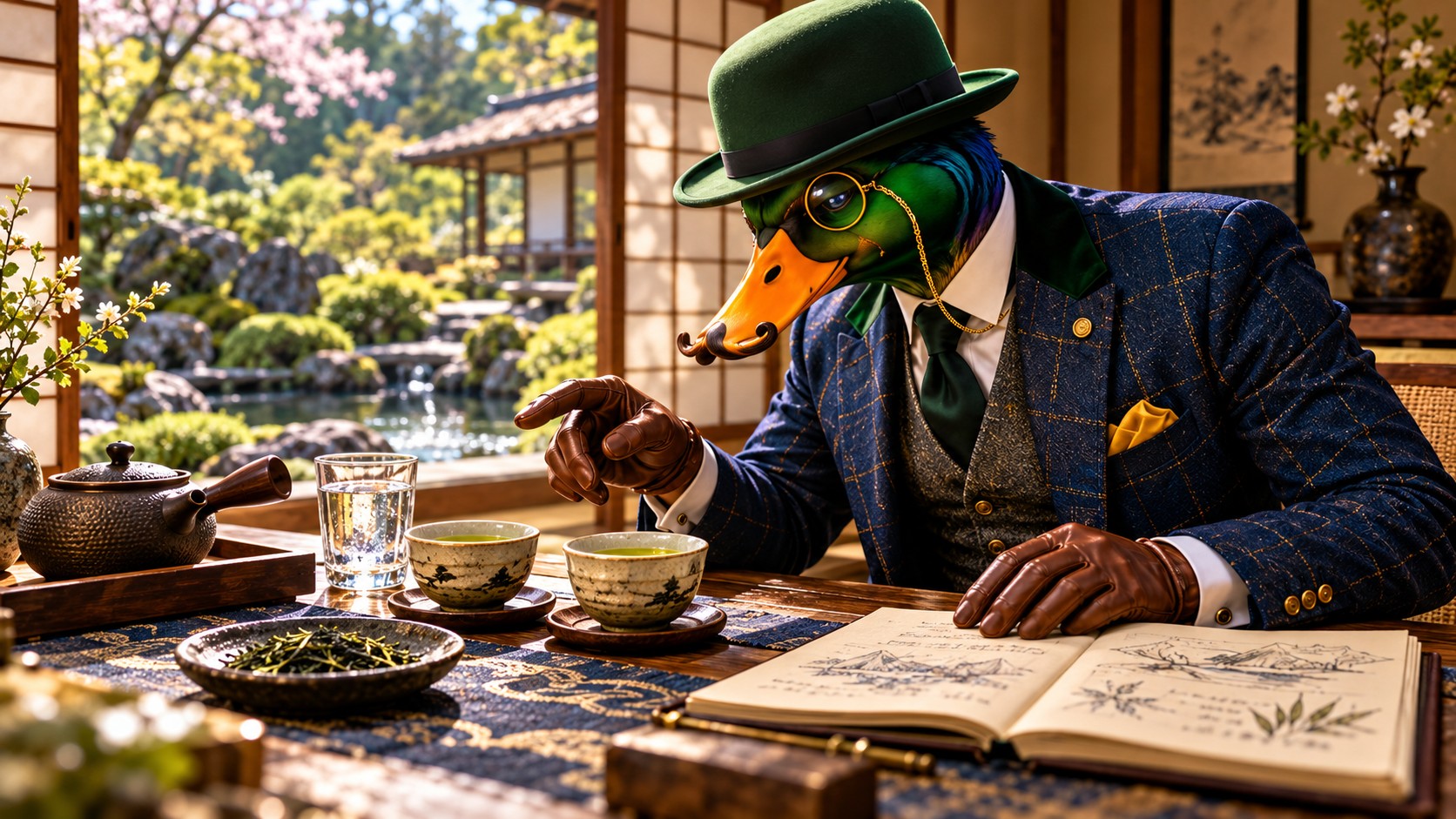
For the next tasting, their host prepared the same sencha with a second drinking water. She kept the amount of leaf, the water temperature, and the brewing time as consistent as she could.
Two matching cups stood on the table. The Professor’s notebook lay open between them.
He found one cup rounder and quieter, the other more briskly defined. His companion preferred the second. The Professor returned to the first, then reconsidered.
“A disagreement,” his companion said.
“A comparison,” the Professor corrected. “We must not rush into having a winner.”
These were impressions from an imagined tasting, not measured results. A tea’s character also depends on the leaf, how it is prepared, and the person drinking it. Changing several things at once would tell them very little about the water.
For the Professor, the useful discovery was the question itself: did he prefer that water in a glass, or that water in this particular tea?
The answers, inconveniently and rather wonderfully, did not have to be identical.
A FAIRER COMPARISON
Keep the tea, temperature, and brewing time consistent.
Change the water. Notice what changes in the cup.
A tasting exercise for curiosity; personal impressions can differ.
05 · A note in the margin
What Water Brings to Tea
The real-world background gives the Professor’s fictional experiment a useful starting point. Kyoto tea specialist Ippodo explains that water hardness can change the character of Japanese tea. Its guidance favours softer water for bringing forward umami in its teas, while harder water can give a crisper impression.
Ippodo also recommends starting with water you enjoy drinking plain, and does not recommend distilled water for its Japanese teas.
The Professor underlined the word starting.
“A sensible beginning,” he said. “Not an excuse to stop paying attention.”
He did not attempt to turn the afternoon into a rule for every tea or every water in Japan. Nor did he write down mineral figures he had not measured. He recorded what they had used, how they had prepared it, and what each of them noticed.
His companion suggested that this was almost a modest approach.
“Please,” said the Professor, “do not put that in the report.”
06 · The journey continues
A Partnership Worth Travelling For
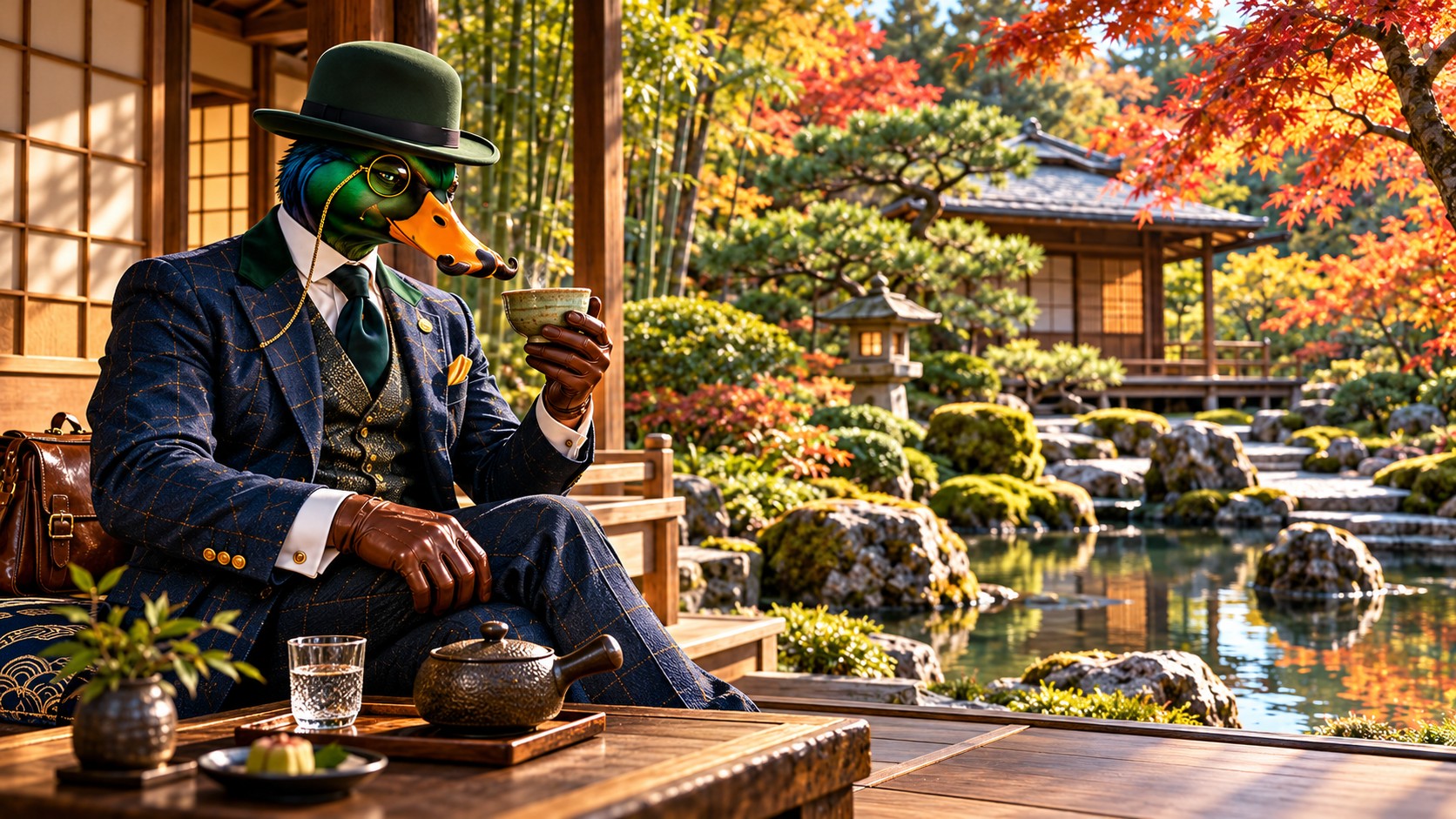
Later, on a wooden veranda overlooking a garden, the Professor set his tasting glass beside a small cup of tea.
Neither looked especially dramatic. A few leaves moved in the breeze. Light fell across the timber. Somewhere inside, their host was preparing another pot.
The title in his notebook had begun as a joke: When Water Met Its Match.
He considered crossing it out.
It described a partnership, he decided. Each brought something the other could reveal.
He left the title where it was.
“Have you changed your mind about water?” his companion asked.
“No,” said the Professor. “I have found another reason to be interested in it.”
He closed his notebook and reached for the cup.
For the next few moments, the report could wait.
“I have found another reason to be interested in it.”
— Professor Mallard, Esq.
About this travel journal
This is a fictional Professor Mallard adventure. The shop, host, dialogue, itinerary, and tasting impressions are invented. The original illustrations are AI-generated artwork based on the approved character reference.
Factual background: Ippodo: Choosing water for Japanese tea and Ippodo: Types of Japanese tea. These sources provide background only; the fictional visit does not depict or imply endorsement by Ippodo.